


In a business world increasingly driven by metrics, analytics, and automation, data is often hailed as your greatest asset. Yet, there’s a paradox: even a small fraction of bad data—1% to 2%—can quietly erode revenue, reputation, and efficiency. That small leak in your data pool can turn into a sinkhole under your business. Let’s explore why even 1% inaccuracy can cost 10% or more of your revenue — with real examples, actionable logic, and tools you can deploy now.
What “Bad Data” Looks Like
Bad data isn’t always dramatic. You might not see bombs going off in your dashboards, but small inconsistencies ripple. Here are common symptoms:
- Duplicate or fragmented records
- Outdated or missing customer info (email, address, phone)
- Incorrect metadata (wrong SKUs, mis-specified attributes)
- Misclassification (wrong source, campaign tags, product categories)
- Inconsistent formats (dates, phone numbers, naming conventions)
Individually, these might affect only a sliver of your total dataset. But compounded across systems — CRM, analytics, fulfillment, marketing — they create distortions that cost real money.
The Mechanisms: How 1% Becomes 10%
Below is a breakdown of the ripple effects of that first 1% error, and how it escalates.
| Stage | What Happens When Data Is Bad | Revenue/Efficiency Leakage |
|---|---|---|
| Lead Capture & Qualification | A small percentage of leads are mis-tagged, duplicates, or missing contact channels. Some never reach sales; others get lost in nurture tracks without proper follow-up. | Potential Δ in conversion from lead → qualified lead; typically a few % lost here. |
| Targeting & Ad Spend | Marketing optimizes for “top performing channels” based on data. If the data is skewed by duplicates or misclassification, ad spend goes into “ghost” segments. | Wasted budget on low-yield audiences; reduced ROI. |
| Forecasting & Strategy | Decision-makers rely on dashboards showing inflated or mis-aligned metrics: e.g. high engagement, but many interactions are with inactive or invalid contacts. Strategy shifts in wrong direction. | Misallocated budget, missed product launches or misprioritized features. |
| Customer Experience & Retention | Duplicate or wrong contact info causes clients to receive duplicate emails or no emails; wrong offers; or inconsistent follow-ups. Frustration builds; churn increases. | Retention suffers; negative word-of-mouth; reactivation costs go up. |
| Regulatory / Compliance / Operational Costs | In regulated industries, errors in identity, documentation or consent data can lead to penalties. In supply chains, wrong product data can lead to returns, listing blocks, or fines. | Legal risk, brand damage, cost of remediation, lost sales. |
When you tally all these effects for a mid-sized to large organization, that initial 1% impairs many workflows, degrading efficiency and cutting a chunk of revenue—often 5-15%, depending on industry, scale, and dependency on digital channels.
Case Studies That Prove It
1. GS1 & Target — Product Data Quality in Retail
A GS1 / Target / Johnson & Johnson / LEGO collaboration uncovered that many product attributes shared by suppliers were non-compliant or inconsistent — weight, dimensions, ingredient labeling, packaging metadata, etc.
- In one audit, only ~71.4% of case-weight data (one attribute) was accurate across suppliers.
- Target built a supplier certification program: vendors were scored on quality; small penalties for persistent errors. Result: attribute accuracy improved tenfold in several categories.
- The financial implication: product listings that failed due to bad metadata meant lost visibility online, rejected catalogs, poor consumer trust, higher returns. While exact revenue loss wasn’t always public, suppliers reported “order rejections” and listing removals costing potentially millions. GS1’s audit of product metadata showed that when simple attributes are wrong, sales drop.
Key takeaway: Errors in “small” data fields (weight, attribute, packaging dimension) can block access to sales channels or reduce visibility, which hits revenue disproportionately to how trivial the error may seem.
2. Vertex’s “Order Cuts” Due to Data Discrepancies
Vertex worked with a major health & beauty supplier that shipped hundreds of millions of dollars of goods through big-box retailers. Orders were often rejected or “cut” because the supplier’s product data (pricing, SKUs, item attributes) did not match retailer requirements.
- The supplier lost up to 2% of total orders from just one retailer due to mismatches. On a business doing half-a-billion in volume, that’s millions in lost revenue.
- Internal efficiency suffered: manual data correction, communication back-and-forth with retailer, penalties for non-compliance.
- After implementing Vertex’s bSync tool for aligning metadata, reducing “exceptions” and automating xchecking, the supplier saw 50%-70% reduction in order cuts and compliance fines.
This is a clear demonstration: even a small fraction of mismatched records leads to real, measurable order losses and financial penalties.
3. Broader Economic Perspective – IBM, SAP, and IDC
- IBM has estimated that poor data quality costs the U.S. economy about $3.1 trillion per year. That includes inefficiencies, bad decisions, lost opportunities.
- Another IBM report, “Cost of a Data Breach 2024”, doesn’t directly measure bad metadata errors, but shows how data leaks, inconsistent data security postures, system misconfigurations contribute to very high costs when breaches happen. The indirect lesson: data hygiene (accuracy, timeliness) strongly correlates with lower risk and less wastage.
Putting It Together: Why That 1% Hurts — Logic Illustrated
Let’s walk through a hypothetical but realistic scenario:
- A company captures 100,000 leads per year. If 1% of those leads contain bad/misclassified data (duplicate, wrong campaign tag, invalid contact info), that’s 1,000 “bad leads”.
- These bad leads may never convert, or convert much later, or cost extra effort to salvage. Suppose clean leads convert at 20%, bad leads at 0–2% → you lose ~180-200 potential customers.
- If average customer lifetime value (CLV) is $1,000, that’s $180,000-200,000 in lost revenue — just from 1% error in the capture process.
- Add misallocation of ad spend: because your dashboards are showing inflated performance on certain channels (due to bad data), you spend more on underperforming sources, raising cost per acquisition.
- Add customer dissatisfaction from poor communication, wrong addresses etc. → increased churn. Across many customers, that 1% error can grow into 5-10% revenue erosion annually.
So the logic chain is:
1% bad data → mis-qualification / duplication → lower conversion & wasted ad spend → poor forecasting & misaligned strategy → customer frustration / churn ⇒ up to 10%+ revenue leakage
What Businesses Should Do: Strategies & Practical Tools
Realizing you have bad data is step one. Fixing it and protecting against future leaks is where competitive advantage emerges. Here are strategic actions, backed by how these companies (GS1, Vertex, big retailers) handled it.
| Strategy | What it Involves | How GS1 / Vertex / Others Did It |
|---|---|---|
| Data Governance & Ownership | Define who owns each data field, who is responsible for cleaning it, oversight policies. | GS1 & Target set up supplier certification programs; Vertex created data-analyst “owners” who handle corrections. |
| Attribute Audits & Physical Verification | Regular audits of product attributes, physical checks of items vs data. | GS1 audits showing “case weight accurate only ~71% of time” before fixes. |
| Automation Tools for Validations & Exception Tracking | Software that flags mismatches automatically; dashboards for data quality metrics. | Vertex’s bSync reduced exceptions (mismatches) dramatically; GS1 / Target used validation software and data quality rules. |
| Aligning Definitions & Metrics Across Teams | “What is a lead?”, “What is qualified?”, “How do we name campaign sources?” — coherence across sales / marketing / operations. | Many data error issues stemmed from inconsistent definitions or inputs; GS1’s supplier program forced unified attribute definitions. |
| Monitoring & Feedback Loops | KPIs for data quality: error rates, rejection rates, manual corrections, mismatches. Dashboard / reporting at least monthly. | Target & GS1 send supplier “scorecards”; Vertex tracks order rejections and penalty fines. |
How to Calculate Your Own Risk (“Revenue Leak” Estimate)
If you want to apply this to your company, here’s a quick calculation framework:
- Estimate total number of leads / customers / products per period (e.g., year).
- Estimate your current bad data rate (duplicates, misclassified, invalid). If you don’t know, sample (let’s say 1–2% is common).
- Estimate conversion rate of clean data vs. bad data. Clean leads might convert at X%, bad leads at much lower.
- Estimate average customer value or deal size.
- Compute lost revenue = (Bad data rate) × (leads) × (difference in conversion) × (average customer value).
Then add operational costs: extra labor for cleaning, lost opportunities, marketing inefficiencies, etc.
Even a conservative estimate often shows 5-10% potential revenue loss annually.
Key Takeaways & Action Plan
To safeguard your revenue from hidden data decay, here are 3-5 next steps you can implement:
- Run a data quality assessment: sample your CRM / marketing database, measure duplication, misclassification, missing fields.
- Define “qualified lead” & “source” clearly across all tools, ensuring consistency.
- Create attribute & metadata audits (for product data, customer attributes, campaign tags). Use tools for automated validation.
- Set up dashboards / KPIs for data quality: % duplicates, % leads missing essential fields, % rejections from partners, etc.
- Institutionalize data governance: assign ownership for data fields, create supplier/vendor programs, feedback loops.
Conclusion
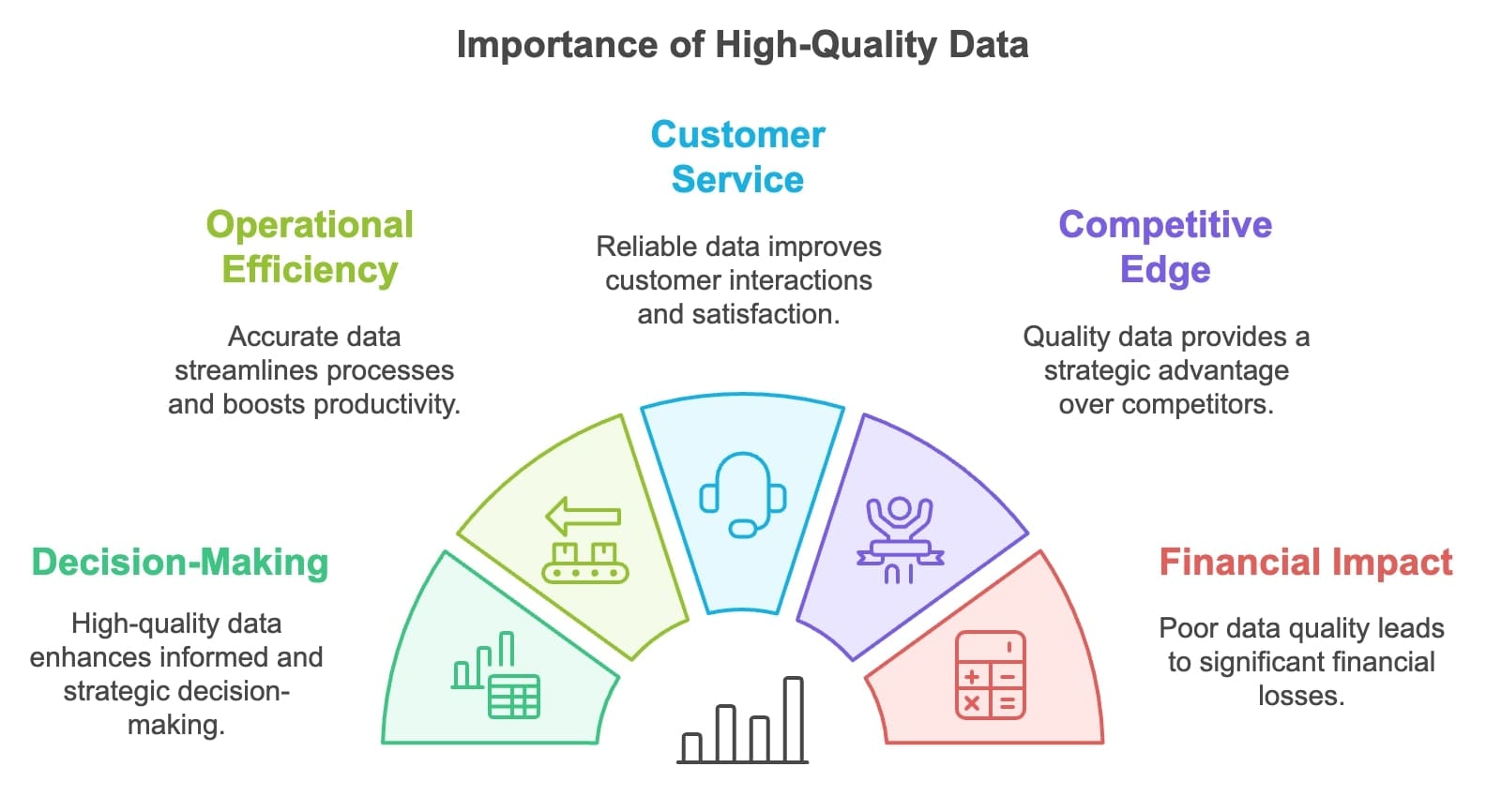
Bad data isn’t flashy. It doesn’t spark alarms — but it erodes foundations. That 1% error doesn't stay isolated; it seeps into every decision, every workflow, every customer interaction.
By combining lessons from GS1, Vertex, and the real cost-studies from IBM, we see a pattern: companies that proactively clean, govern, and monitor their data don’t just plug revenue leaks — they gain competitive advantage.
Because when you think about it, 1% inaccuracy costing 10% revenue isn’t pessimism. It’s simple arithmetic — multiplied by scale, repeated through systems, and ultimately felt on your bottom line.